
Add Print Template
Table of Contents
1. Features
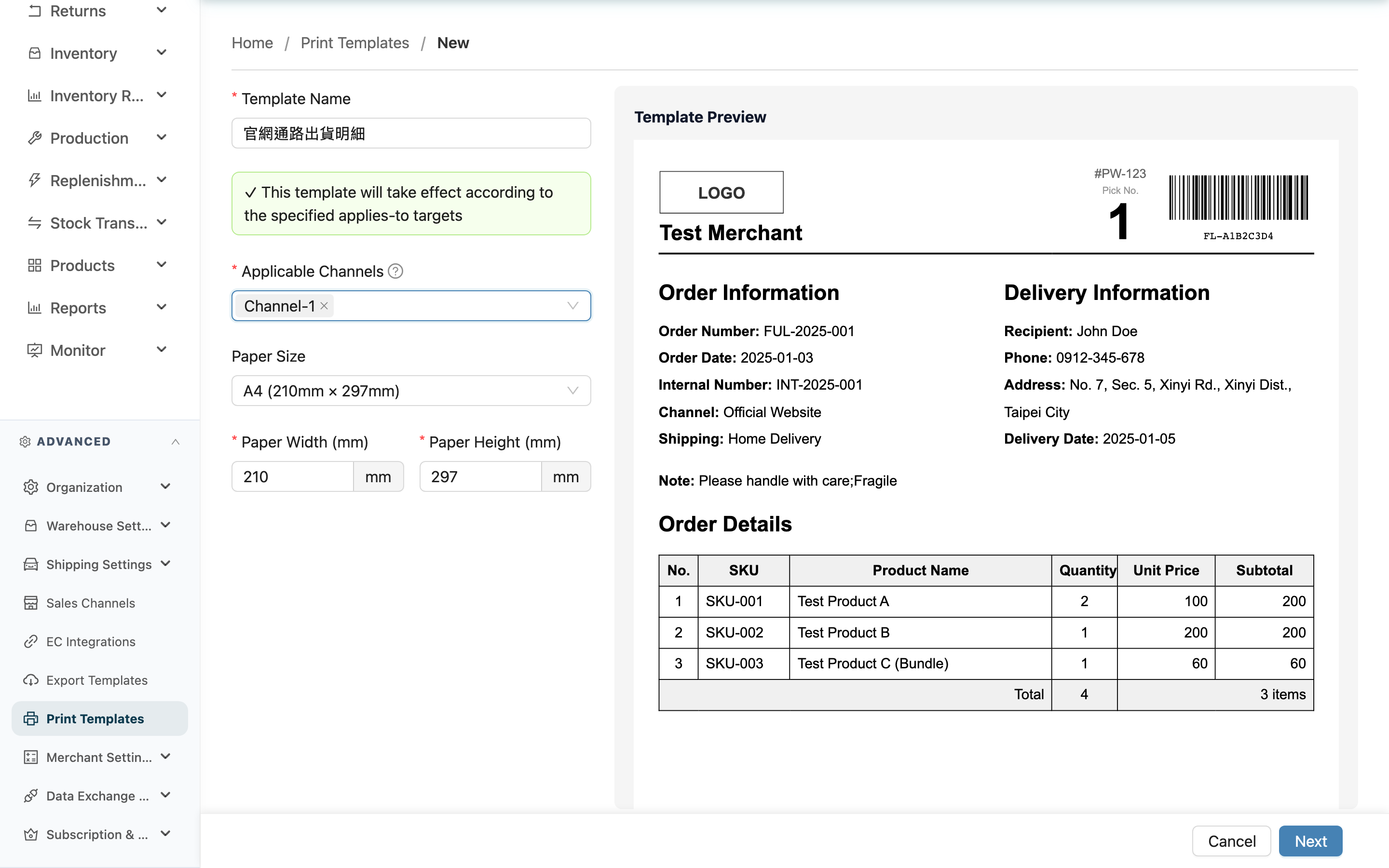
Creating a template happens in two steps: first decide what the template is, who it belongs to, and what size paper it prints on, then edit the actual layout content. A preview stays visible on the right the whole time, so you see the result the moment you change a line — no need to save and print a test copy just to check. You don't have to start from a blank page either — the system pre-fills the default layout for that type, and you edit from there.
Quick jump: Choose a Template Type | Step 1: Basic Info | Step 2: Layout Content | Save
1.1 Choose a Template Type
Clicking New on the list page first shows Select Template Type. Only after you choose one do you reach the form, because the fields you can fill in differ by type — and the type can't be changed once chosen. If you pick the wrong type, the only option is to delete it and create a new one. See Template Types for what each type is for.
When the currently selected warehouse uses virtual storage locations, Shelf Label won't appear in the list of types you can choose.
1.2 Step 1: Basic Info
Fields marked with * are required
| Field | How to Fill In | Notes |
|---|---|---|
| *Template Name | Give it a name you can recognize at print time, for example "Brand A Packing Slip (Website)" | Parcel Slip allows up to 255 characters; Parcel Slip, Shelf Label, and Custom Shipping Label cannot share a name within the same scope |
| Owner | Choose Merchant Level for a single merchant to use, or Organization Level for the whole organization to share | Only Parcel Slip lets you choose between both levels; other types have a fixed level and this option won't appear |
| *Merchant | Appears only for Parcel Slip when you choose Merchant Level; choose which merchant this template serves | Only merchants you're authorized to manage can be chosen. The other merchant-level kinds (Fulfillment Detail, Product Label) do not show this field — ownership is simply the merchant you currently have selected, and if none is selected yet the page asks you to pick one before showing the form |
| Set as default | Turning this on means documents at this level with no specified template will use it | The switch's label changes to that merchant's default or the organization default depending on the level; Fulfillment Detail and Custom Shipping Label have no concept of a default, so this switch won't appear |
| Applicable Channels | Choose which channels' documents should use this template | Required only when specifying channels is the type's single way of taking effect automatically — Fulfillment Detail has no default to fall back on, so it is required; Parcel Slip can take effect through a default instead, so it is optional. Only merchant-level templates can bind to channels, so the field is hidden when the level is Organization Level, and any channels you already picked are cleared — switch back to Merchant Level and you have to pick them again. Only channels under this template's own merchant are selectable |
| Applicable Shipping Types | Choose which custom shipping types' shipping labels should use this template | Only Custom Shipping Label has this field. It has no default to fall back on either, but the same binding can also be changed on the Shipping Types page, so it is optional here |
| *Paper Size | Pick a common paper size, or enter the width and height in millimeters directly | You can still adjust the numbers by hand after picking a paper size; width and height must be greater than 0, and the inputs accept 1mm at the lowest. Shelf Label offers no common paper sizes to pick from — enter the numbers directly; its width is limited to 20–300mm and height to 15–300mm |
Product Label doesn't specify what it applies to here — that's done one by one on each product's record instead (see Edit Product), so this page only shows a single line explaining that.
The hint below the fields tells you in real time under what conditions this template will be used once it's created. When it shows the yellow hint about not being set as a default and having no applies-to target, this template won't take effect automatically once created. Only Product Label and Shelf Label can be picked manually at print time; the other three will never be printed while in this state.
Click Next once you're done to move to the next step; if a required field is missing, you'll stay on this step with that field flagged.
1.3 Step 2: Layout Content
| Tool | Purpose |
|---|---|
| Start from a built-in layout | Shelf Label offers four ready-made layouts: Big Text + Barcode, Big Text + QR Code, Detailed, and Product Info. Picking one directly overwrites the current content and size. Other types only have one default layout, so this menu isn't shown |
| Edit HTML | Opens the editor to modify the layout. The preview on the right updates as you go |
| View Variables | View which fields are available for this type (such as order number, recipient, product name) and the correct way to write them |
| AI Assistant | Describe the layout you want in a conversation, and the system rewrites the content for you. Only available for Fulfillment Detail |
| Load Product Data | For Product Label only: pick a real product as the preview sample, to confirm long names and long specs don't break the layout. Click Reset to Sample Data to switch back to the sample data |
| Description | Enter a note about the purpose, for example "For website channel only, includes return policy", to help you tell apart similar-looking templates in the list later |
Until you pick a real product, the preview uses the sample data the system provides — not a real order or product.
1.4 Save
Clicking Save and Add Another saves the template and clears the form, keeping you on this page to create the next one — handy when you need to build several at once. Submitting normally saves the template and takes you to its detail page.
Before submitting, the system checks the layout content: Fulfillment Detail must keep the picking barcode variable, or the warehouse won't be able to scan the barcode; Parcel Slip must include a <head> tag, or printing will fail. If there's a syntax error in the layout, submission is also blocked and the error is pointed out.
2. FAQ
2.1 FAQ
▪ I picked the wrong template type — can I change it?
No. The type determines which fields you can fill in and which layout fields are available, and it can't be changed after creation — delete it and create a new one instead.
▪ Why can't I see Owner or the default switch for some types?
Both are determined by the template type. Only Parcel Slip lets you choose the level; Fulfillment Detail and Custom Shipping Label have no concept of a default, so the default switch doesn't appear for them. See Template Types for the differences between types.
▪ I already chose Applicable Channels — can I also set this as the default?
No. A template only takes effect one way — once you specify what it applies to, you can't also set it as the default, and vice versa.
▪ I picked A4 for the paper size, but I want it slightly narrower?
The paper size menu is just a shortcut to fill in width and height — after picking one, you can edit the numbers directly, no need to switch to a different mode. On the list page, the size column shows the paper name when the numbers exactly match a common size, otherwise it shows the dimensions in millimeters.
▪ It says the name is already in use after I submit?
Parcel Slip, Shelf Label, and Custom Shipping Label don't allow duplicate names within the same scope — just choose a different name.
▪ I can't find a merchant in the Merchant dropdown?
It only lists merchants you're authorized to manage. If you can't find one, contact your administrator to check your authorized scope.
2.2 Notes
⚠️ Important
- The template type can't be changed once created.
- Turning on the default switch and saving immediately un-sets the previous default in the same scope — that merchant's documents will then print with the new layout.
- Start from a built-in layout directly overwrites content and size you've already edited — picking it partway through your edits will lose your changes.
💡 Tip: Product Label layouts are most likely to break on long product names or long specs. Before saving, use Load Product Data to check with the product that has the longest name — it's the safest way to be sure.
3. Related Features
| Feature | Description | Link |
|---|---|---|
| Print Templates | Return to the list to view all templates | Go |
| Print Template Detail | View the layout of the template you just created | Go |
| Edit Print Template | Modify an existing template | Go |