
Manage apps
Contents
1. Scenarios
Scenario 1: Use a warehouse tool provided by your team
Situation: Your team has provided an additional warehouse tool for daily operations. You need to perform warehouse tasks within your assigned permissions.
Use this feature: Open an installed tool.
Result: You use the organization’s tool within your operation permissions and assigned warehouse.
2. Features
Open this page from “Advanced” → “Apps” → “Manage apps” in the sidebar.
This page lists apps installed for your organization. No merchant selection is required. You can open a tool or stop its access. Users with integration management permission can browse and install apps after reviewing their permissions. Changing the header merchant does not change this list. Online App operations follow your current operator permissions and assigned warehouse.
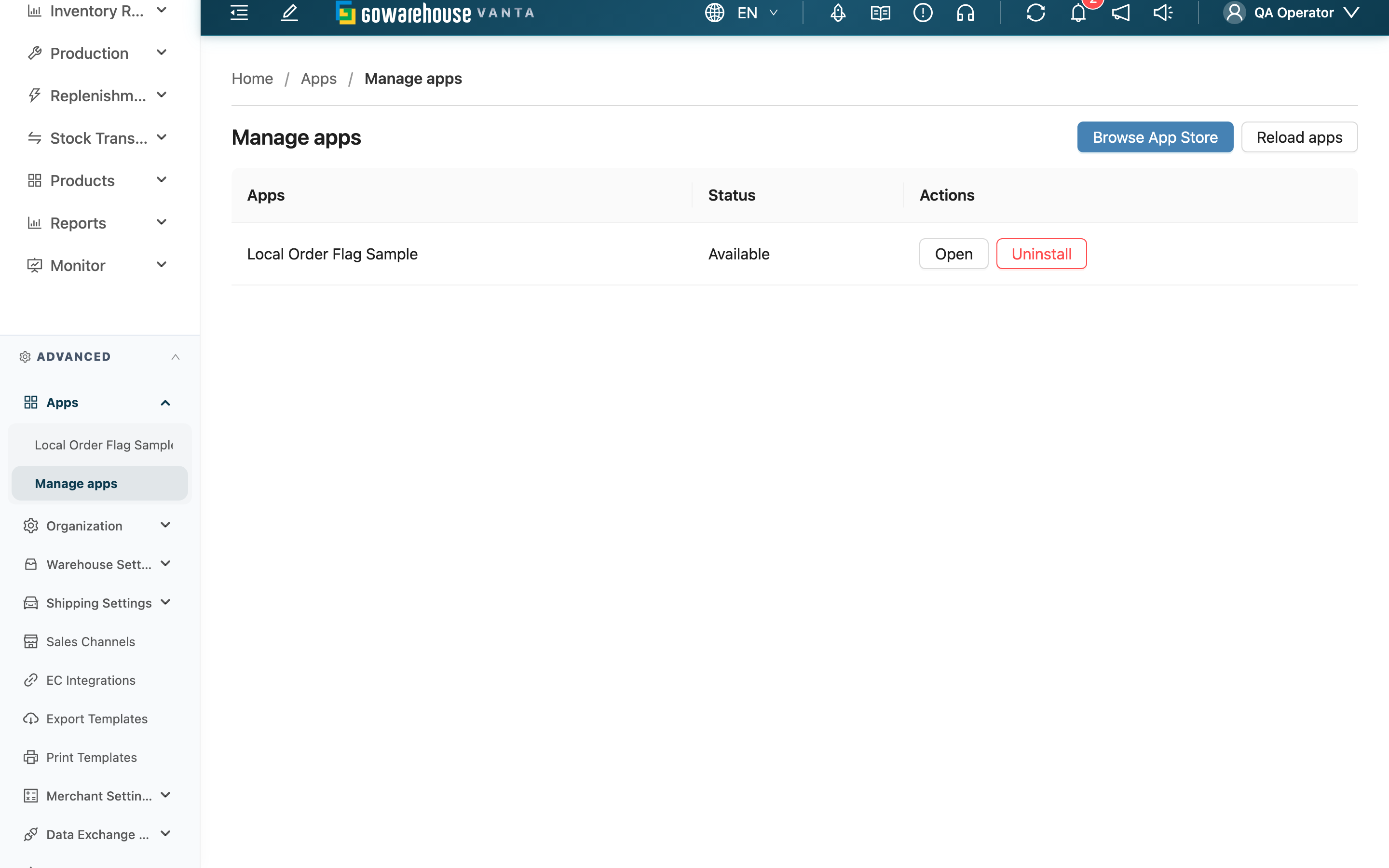
2.1 Open an app and check availability
Opening an app requires integration viewing permission. Expand “Apps” in the sidebar and select an installed app by name. Select “Manage apps” to return to the installation list. You can also select “Open” from the list.
The app fills the console’s content area, with the sidebar retained. Use “Manage apps” in the sidebar or your browser’s Back button to return. You can bookmark this page or open it in a new tab; reloading checks your current access again.
“Available” allows opening; “Suspended” does not. An empty list means this organization has no installed apps. Contact the team that provides the tool.
Online organization app operations follow the current operator’s permission and warehouse. The header merchant filter and merchant assignments do not restrict the WCS API. Background jobs authorized by installation consent can access warehouses across this organization. Uninstalling stops further access.
2.2 Uninstall
Integration management permission is required. Select “Uninstall” and confirm to remove the app from the organization’s list and sidebar and invalidate its existing access. Uninstalling does not cancel orders or change inventory, and order flags the app already wrote are kept. Follow the installation flow to install it again.
2.3 Install from App Store
- Select “Browse App Store” to open App Store in the same tab with the current installation owner.
- Open an app’s details and select Install to return to this page. In the confirmation dialog, review the app icon and name, publisher, “Install for” and requested permissions. Expand “Details” to view the version and app domains.
- Enable “I agree to grant these permissions.”, then select “Agree and install”. After installation, the page reloads and the app appears in the installed list and sidebar.
Operator installations belong to the current organization; no merchant selection is required.
Selecting a version does not install it. Cancelling grants no permissions and does not affect existing tools. If the app already has an active installation, choosing another version does not overwrite it.
3. FAQ
3.1 Questions
▪ Why is an app missing?
No merchant selection is needed. If the list is empty, ask the team to check that the app is installed for your current organization. If the menu is missing, ask an administrator to check integration viewing permission.
▪ What should I do when the app expires?
Reload the page in your browser, or return to the list and open the app again. Changing warehouses, signing out, changing permissions or uninstalling can invalidate an existing window. Closing it does not undo completed operations; check saved results before retrying.
▪ What if an app does not load?
If the installation list does not load, select “Reload apps” to reload it. A loading indicator appears while the app connects. If it has not connected within 15 seconds, an error screen offers “Reload apps” to open it again. If it still cannot open, share the app name and error message with the team that provides it.
▪ Why can’t I select Browse App Store?
Ask an administrator to check that you have integration management permission.
▪ What if confirmation expires or installation fails?
After signing out, changing accounts or losing permission, select the app and version again. Retry temporary connection failures; if a version has been withdrawn, select another available version. If the store cannot open, ask an administrator to check the App Store connection settings. Share persistent errors with an administrator.
▪ Does an installed app automatically move to its new website?
No. An installed app keeps the name, description and version selected at installation. Later store edits or publications do not change your existing installation. Its original website origin is also preserved. To use an approved new version, uninstall the old version, then select the new version from App Store. Review its new domains and requested permissions before confirming installation. Uninstalling immediately invalidates existing windows and access; reinstalling does not restore old windows.
▪ Why is an app name or action button in another language?
App names and action buttons use translations included with the installed app. When no matching translation is available, the app’s default language is shown. Traditional and Simplified Chinese do not automatically substitute for each other; either may still appear if the app uses it as its default language.
3.2 Notices
⚠️ Important
- Uninstalling stops the app’s access immediately. Reinstalling does not restore access for old windows.
4. Related Features
| Feature | Purpose | Link |
|---|---|---|
| Order list | Select orders for a bulk tool | Open |
| Order details | Check order progress | Open |