
Print Templates
Table of Contents
1. Use Cases
Quick links: Print a merchant's own layout on their documents | Switch layouts for the same merchant by channel or product | Labels and shipping labels the warehouse prints for itself
Scenario 1: Print a merchant's own layout on their documents
Situation: A newly onboarded skincare brand wants the packing slip that ships with their orders to carry their own logo, return policy, and customer service phone number — the warehouse's default layout won't do. Since the warehouse ships for a dozen or more merchants every day, it's not practical to remind staff every single time which layout to pick for this merchant.
Use this feature: Create a Fulfillment Detail template, assign it to that merchant, and specify which Applicable Channels it applies to (see Template Types, Add Print Template).
Result: Orders coming in through those channels for that merchant automatically use this layout when the fulfillment is printed — warehouse staff never have to manually pick a template, and never pick the wrong one.
Scenario 2: Switch layouts for the same merchant by channel or product
Situation: The same merchant sells through both their own website and an ecommerce platform, and the platform requires specific wording on the documents. Meanwhile, this merchant also has a batch of gift-box products whose labels need to print larger than regular products.
Use this feature: For Fulfillment Detail, use Applicable Channels to tell layouts apart by channel; for Product Label, assign a template on the product record for that batch of gift-box products (see Edit Product) — every other product keeps using the merchant's default template.
Result: The same shipment automatically switches to the right layout by channel and by product, without forcing every document onto manual selection just to handle a few exceptions.
Scenario 3: Labels and shipping labels the warehouse prints for itself
Situation: The warehouse opens a new storage zone that needs shelf labels; separately, a batch of orders ships through a shipping type the warehouse set up itself (for example, customer pickup at the warehouse), which has no carrier to request a tracking number from and therefore no ready-made shipping label to print.
Use this feature: Shelf Label and Custom Shipping Label are also created on this same page. Once a custom shipping label template is built, bind it to the matching custom shipping type under Shipping Types (see Shipping Types).
Result: Merchant document layouts and the warehouse's own labels and shipping labels are all maintained on the same page — you don't need to remember a different place to change each type of print.
2. Features
The packing slips, parcel slips, product labels, shelf labels, and custom shipping labels the warehouse prints every day all follow a layout decided by a template. This page brings all five kinds of print templates into a single list: here you create a layout, decide which merchant it belongs to, and set the conditions under which it gets picked automatically. Once set up, day-to-day printing doesn't require picking a template each time — the system decides which one to use based on the scope it applies to.
Quick jump: Template Types | Which Template Gets Used When Printing | Search & Filter | List Columns
2.1 Template Types
The list covers five template types, which differ in what document they print, who the template belongs to, and how they get picked automatically:
| Template Type | What It Prints | Belongs To | How It Takes Effect Automatically |
|---|---|---|---|
| Fulfillment Detail | The packing slip that ships with the order | Merchant level | Can only be scoped by Applicable Channels; has no default |
| Parcel Slip | Parcel/box contents slip | Merchant level or organization level | Set as the default for that merchant or for the whole organization, or specify Applicable Channels (only merchant-level templates can bind to channels) |
| Product Label | Product label | Merchant level | Set as that merchant's default; can also be assigned to individual products on the product record |
| Shelf Label | Shelf label | Organization level | Set as the organization default |
| Custom Shipping Label | Shipping label for custom shipping types | Organization level | Bound to a custom shipping type under Shipping Types, or chosen via Applicable Shipping Types on the template |
Shelf Label only applies to warehouses with physical storage locations; when the currently selected warehouse uses virtual storage locations, this type won't appear on the create page.
2.2 Which Template Gets Used When Printing
The same type of document may have several templates at once. When printing, the system searches from the narrowest to the widest scope and stops at the first match:
- The template manually chosen at print time — for example, picking one yourself when printing a label from the product detail page.
- The specified target it applies to — Fulfillment Detail and Parcel Slip look at the order's channel, the product label looks at the template assigned on the product, and the custom shipping label looks at the template bound to the shipping type. A Parcel Slip is printed for a whole fulfillment, so it looks at the channel of the earliest-placed order in that fulfillment.
- That merchant's default template.
- The organization default template — used when the merchant has no default of their own.
- The system's built-in default layout — used when none of the above exist, so there is never a case where nothing can be printed.
⚠️ Custom Shipping Label is the one exception: it only uses step 2 — it has no default and no built-in layout to fall back on. A Custom Shipping Label that is not bound to a shipping type, and a custom shipping type with neither a bound template nor a manually uploaded label, produce no shipping label at all — a built-in layout is not printed instead.
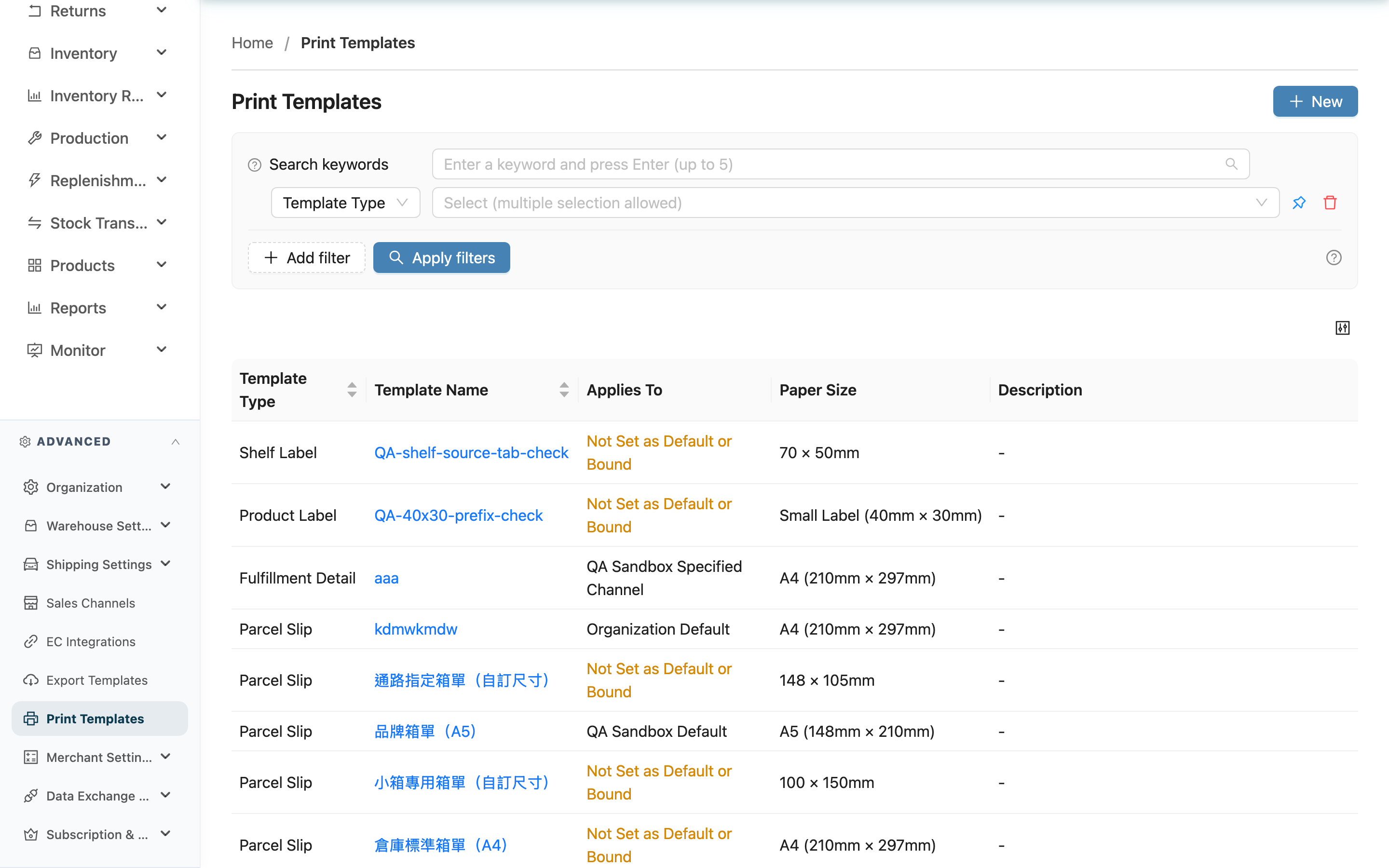
The Applies To column in the list shows which of steps 2 through 4 this template falls under. When it shows "Not Set as Default or Bound" in yellow text, this template has no way of being picked automatically. Of the five types, only Product Label and Shelf Label can be picked manually at print time; the other three have no selection entry point on their print screens, so for them the yellow text means "it will never be printed" — they have to be set as a default or given an applies-to target to take effect.
2.3 Search & Filter
The search box above matches by Template Name or Description keyword. The filters let you narrow down by Template Type and Template Name; when you're authorized to manage more than one merchant, an additional Merchant filter appears. Filtering by Merchant only lists templates belonging to that merchant — organization-level shared templates won't show up together with it.
2.4 List Columns
| Column | Description |
|---|---|
| Template Type | Which type of document this template prints (see Template Types) |
| Template Name | Click to open the detail page and view the layout and content |
| Applies To | Under what conditions this template is picked automatically (see Which Template Gets Used When Printing) |
| Paper Size | The actual output size. Shows the paper name when it exactly matches a common paper size, otherwise shows the dimensions in millimeters |
| Description | The notes entered when the template was created, used to tell apart templates with similar layouts |
The New button in the top right leads to Add Print Template; clicking a template name opens Print Template Detail, where editing and deleting are both done. The New button won't appear if you don't have edit permission for print templates.
3. FAQ
3.1 FAQ
▪ I created a template, so why does it still print the old layout?
First check the Applies To column in the list. If it shows "Not Set as Default or Bound", this template has no way of taking effect automatically, and printing will still follow the order in Which Template Gets Used When Printing to find a different one. Set it as the default, or specify what it applies to.
▪ Can the same merchant have two default templates?
Within the same type and the same scope, there can only be one default. When you set a new template as the default, the previous one is automatically un-set — you don't need to turn it off manually first.
▪ Why can't a template that's already scoped to a channel also be set as the default?
A template only takes effect one way. A template that already specifies what it applies to is meant to serve only those targets; if it were also the default, documents with no specified target would use it too, and the two intents would conflict — so the system only allows one or the other.
▪ Why doesn't Fulfillment Detail have a "set as default" switch?
Packing slips currently only take effect through Applicable Channels, so the default switch doesn't appear when adding or editing one, and Applicable Channels is required instead. If no template matches the channel, the system's built-in default layout is used when printing.
▪ Why can't I find Shelf Label on the add page?
When the currently selected warehouse uses virtual storage locations, there are no physical storage locations to attach a label to, so this type won't appear in the list of types you can create. Switch to a warehouse with physical storage locations to create one.
▪ Can template names be duplicated?
Parcel Slip, Shelf Label, and Custom Shipping Label cannot share a name within the same scope — submitting a duplicate name shows an error that the name is already in use. The other two types have no such restriction, but it's still a good idea to use names you can tell apart, so you can pick the right one when printing.
▪ What happens to documents that already used a template after it's deleted?
First check whether it specifies Applicable Channels: a template still bound to channels cannot be deleted — you get "This template is still bound to a sales channel and cannot be deleted", and you have to unselect those channels first.
Otherwise it deletes, and the bindings are cleared automatically. Product Label clears the assignment on the products, and those products then print with the default or the system's built-in layout.
⚠️ Take extra care with Custom Shipping Label: deleting it clears the binding on the shipping types, and those custom shipping types then stop producing shipping labels altogether — they do not fall back to a built-in layout — unless you go back to uploading labels manually. Files already printed are unaffected.
▪ I can't see the Print Templates menu, or I can see it but can't create a template?
Viewing and creating are two separate permissions. Not seeing the menu means you don't have view permission; seeing it but not seeing the New button or the edit/delete buttons means you only have view permission. Contact your administrator to check your permissions.
3.2 Notes
⚠️ Important
- Deleting a template cannot be undone. A template still bound to channels is blocked and cannot be deleted; one bound to products can be deleted, and those products fall back to the default or the system's built-in layout.
- Deleting a Custom Shipping Label that is bound to shipping types makes those custom shipping types stop producing shipping labels altogether — not fall back to a built-in layout. Unselecting Applicable Shipping Types has the same effect.
- Setting a template as the default also un-sets the previous default in the same scope — that merchant's documents will immediately switch to the new layout.
- An organization default affects every merchant in the organization that has no default of their own, not just the one you currently have selected.
💡 Tip: Yellow text in the Applies To column is a signal that "this template won't be picked automatically." After creating a template, glance back at the list to catch any template you forgot to configure.
4. Related Features
| Feature | Description | Link |
|---|---|---|
| Add Print Template | Create a new print template | Go |
| Print Template Detail | View the layout, preview, and delete | Go |
| Edit Product | Assign Label template to an individual product | Go |
| Shipping Types | Bind Custom Shipping Label to a custom shipping type | Go |
| Sales Channels | View which channels a merchant has available to specify | Go |